Use cases · Funders · Worked scenario
Tracking NIH-funded datasets
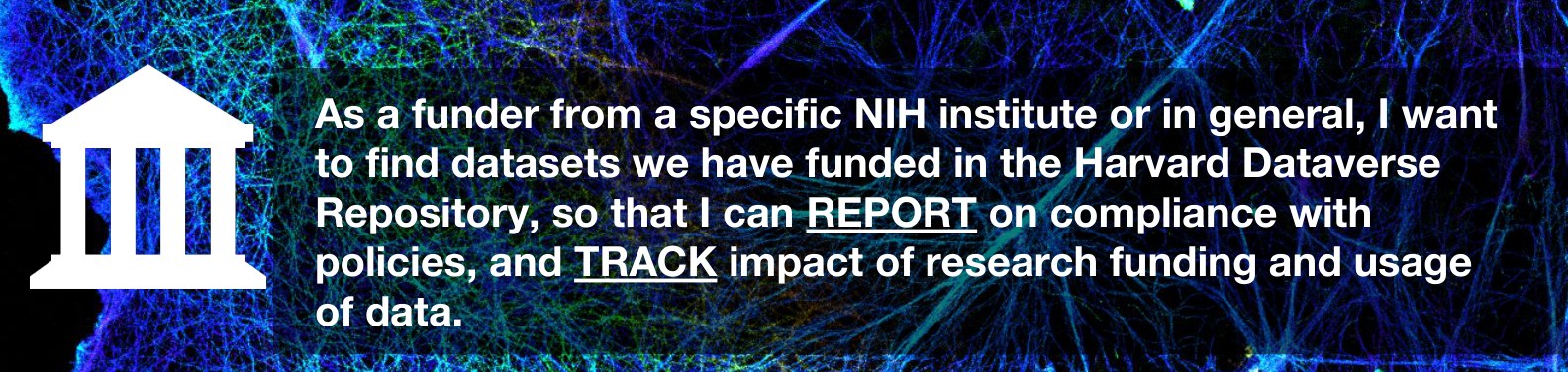
This fictitious use case highlights ways funders can leverage generalist repositories to track compliance with data sharing policies and understand data reuse.
Use case date: February 2, 2023
Use case contact: Julian Gautier, support@dataverse.harvard.edu

Background
A Health Scientist Administrator at the NIH's Office of Data Sharing needs to report on the published data that's been created during research funded by a particular grant. While reviewing a research article published by one of the principal investigators funded by the grant, the administrator follows a citation to one of the PI's datasets in the Harvard Dataverse Repository and searches the repository to see if it contains more data associated with the grant.
Use case
To find other data in the repository created during research funded by the grant, the administrator pastes the grant number into the repository's search box. That search returns five datasets. She clicks on some of the datasets to see how the data is related to the grant and sees the PI's name listed as an author for some of the datasets.
When the administrator is certain that she's found all data created during the grant-funded research, she lists each DOI in the report.

GREI Use Cases are supported by the National Institutes of Health (NIH) Office of Data Science Strategy / Office of the NIH Director pursuant to OTA-21-009, "Generalist Repository Ecosystem Initiative (GREI)".
Header image: NIH Image Gallery. GDF10 protein forms new brain cell connections (https://www.flickr.com/photos/nihgov/22798807131/). Courtesy of S. Thomas Carmichael, MD, PhD, David Geffen School of Medicine at the University of California Los Angeles. NIH funding: National Institute of Neurological Disorders and Stroke (NINDS). More information at https://www.nih.gov/news-events/news-releases/scientists-identify-main-component-brain-repair-after-stroke