Use cases · Researchers · Worked scenario
Sharing big data
This use case highlights ways generalist repositories support Big Data via specialized functionality for large and complex datasets.
Dataset Details
Dataset Title: DrivAerNet++: Pressure
Investigators and affiliations: Elrefaie, Mohamed (MIT); Ahmed, Faez (MIT); Dai, Angela (TUM); Morar, Florin (BETA CAE SYSTEMS USA)
Date: November, 2024
Data type: Visualization Toolkit (VTK)
Citations:
Elrefaie, Mohamed; Morar, Florin; Dai, Angela; Ahmed, Faez, 2024, "DrivAerNet++: Wall Shear Stress", https://doi.org/10.7910/DVN/PCZYL4, Harvard Dataverse, V1
Use Case Date: 2025-01-14
Use case Contact: support@dataverse.harvard.edu

Background
Researchers at Massachusetts Institute of Technology (MIT), the Technical University of Munich (TUM), BETA CAE Systems, and BikeCAD collaborated on a project producing four datasets, each with over 8,000 files, totalling 16 T of data. They packaged the individual files in zip files to support easier downloading for data reusers. Then, they uploaded them to Harvard Dataverse Repository. The project is completed, the datasets will not be versioned, and the collection will not grow.
The data files themselves are stored on tape resources at the Northeast Storage Exchange (NESE). Datasets are downloaded using the Globus protocol and app.
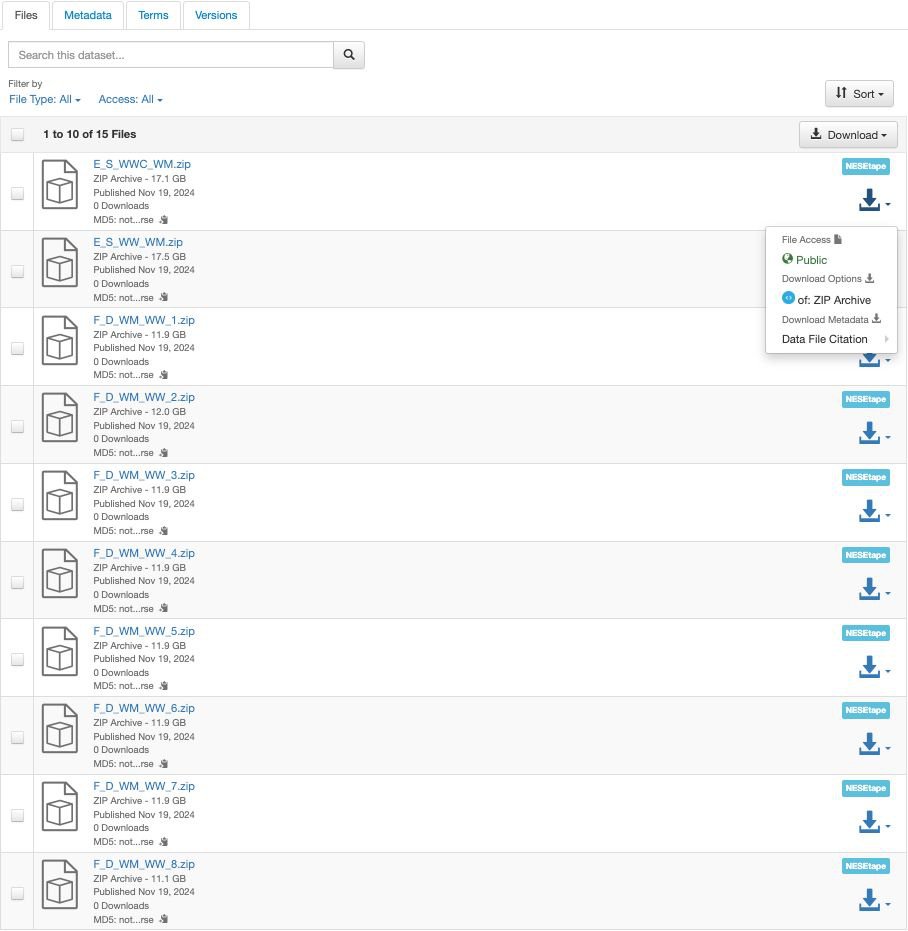

Screenshots of the file landing page for one of the project's datasets. Note the zip files available for download and the icon indicating the files are stored on NESE tape resources.
GREI Use Cases are supported by the National Institutes of Health (NIH) Office of Data Science Strategy / Office of the NIH Director pursuant to OTA-21-009, "Generalist Repository Ecosystem Initiative (GREI)".
Header image: NIH Image Gallery. GDF10 protein forms new brain cell connections (https://www.flickr.com/photos/nihgov/22798807131/). Courtesy of S. Thomas Carmichael, MD, PhD, David Geffen School of Medicine at the University of California Los Angeles. NIH funding: National Institute of Neurological Disorders and Stroke (NINDS). More information at https://www.nih.gov/news-events/news-releases/scientists-identify-main-component-brain-repair-after-stroke